
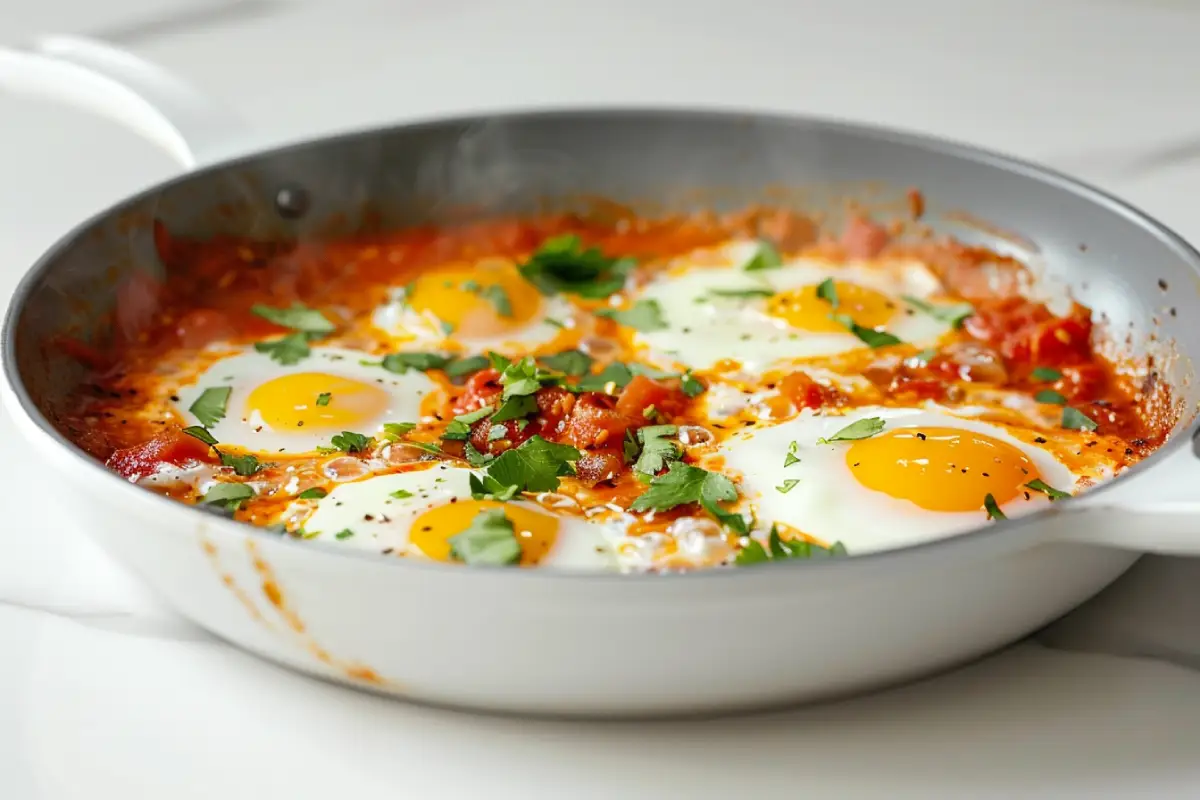
Shakshuka looks easy.
That’s usually the first mistake.
At a glance, it’s just eggs in tomato sauce, cooked in one pan, eaten with bread. But anyone who has made it more than once knows how quickly it can fall flat. Too sharp. Too watery. Eggs overcooked before the sauce ever finds its balance.
This guide isn’t here to romanticize the dish or dress it up with borrowed memories. It’s here to explain why shakshuka works when it works, why it fails so often at home, and how to control the small details that make the difference.
No shortcuts.
No fluff.
Just a method that holds up.
Table Of Contents
Table of Contents

Shakshuka: A Practical, Grounded Guide to Eggs in Tomato Sauce
This shakshuka is a simple, stove-top dish made with eggs gently cooked in a spiced tomato sauce.
It’s meant to be eaten straight from the pan with bread, not plated or overworked.
The focus is on timing, heat control, and letting the sauce fully develop before adding the eggs.
- Total Time: 40 minutes
- Yield: 4 servings 1x
Ingredients
2 tbsp olive oil
1 large onion, finely chopped
1 red bell pepper, sliced thin
4 garlic cloves, minced
1½ tsp ground cumin
1 tsp smoked paprika
¼ tsp chili flakes (optional)
1 can (28 oz) crushed tomatoes
Salt & black pepper, to taste
6 large eggs
Warm bread, for serving
Instructions
1. Heat the olive oil in a wide skillet over medium heat.
2. Add the onion and bell pepper and cook until fully soft, about 10–12 minutes.
3. Stir in the garlic, cumin, smoked paprika, and chili flakes and cook briefly until fragrant.
4. Add the crushed tomatoes, season generously with salt and black pepper, and reduce heat.
5. Simmer uncovered for 15–20 minutes until the sauce thickens and loses its raw tomato taste.
6. Lower the heat to medium-low and make shallow wells in the sauce.
7. Crack the eggs into the wells and season them lightly with salt.
8. Cover the pan and cook until the egg whites are set but the yolks are still soft, about 6–8 minutes.
9. Remove from heat and serve immediately with warm bread.
Notes
The sauce should taste good on its own before the eggs are added.
If the sauce is thin, let it simmer longer rather than increasing the heat.
Leftover sauce can be refrigerated and reheated with fresh eggs the next day.
- Prep Time: 10 minutes
- Cook Time: 30 minutes
- Category: Breakfast
- Method: Stovetop
- Cuisine: Middle Eastern
- Diet: Vegetarian
Nutrition
- Serving Size: 1 serving
- Calories: 230
- Sugar: 8g
- Sodium: 520mg
- Fat: 14g
- Saturated Fat: 3.5g
- Unsaturated Fat: 9g
- Trans Fat: 0g
- Carbohydrates: 14g
- Fiber: 4g
- Protein: 12g
- Cholesterol: 185mg
What Is Shakshuka?
At its core, shakshuka is a North African and Middle Eastern dish made by gently cooking eggs directly in a spiced tomato sauce. It’s traditionally served as a breakfast dish, especially in Israel and across North Africa, but it’s flexible enough to appear at lunch or dinner without apology.
The sauce is built first.
The eggs come later.
That order matters.
Tomatoes provide acidity and body.
Spices add warmth, not heat.
Eggs soften the whole thing, creating contrast instead of competition.
It’s a simple idea, but a fragile one.
Where Shakshuka Comes From (And Why That Matters)
The word shakshuka comes from Arabic, meaning “mixture.” That alone explains why there’s no single, rigid version.
The dish originated in North Africa, where tomatoes, peppers, and spices formed the backbone of everyday cooking. As it traveled through the Middle East, it adapted to local tastes and ingredients. In Israel, it became a staple Israeli breakfast, often served bubbling hot in cast iron skillets.
You’ll see endless variations, but the technique remains the same:
- Build a flavorful tomato base
- Control moisture
- Add eggs only when the sauce is ready
Everything else is negotiable.
Why Shakshuka Often Disappoints at Home
Most home versions fail quietly.
The sauce tastes thin but you can’t explain why.
The eggs cook, but the dish feels unfinished.
You reach for more spice when what you needed was patience.
Common reasons:
- The onions weren’t cooked long enough
- The tomatoes didn’t reduce
- The heat stayed too high
- The sauce wasn’t seasoned aggressively enough
Once the eggs go in, your ability to fix problems drops sharply.
Test Note:
If you wouldn’t happily eat the sauce with bread before adding eggs, stop and adjust. Eggs don’t improve weak sauce — they expose it.
Ingredients for the Shakshuka Base
These ingredients build the entire dish.
Nothing fancy. Nothing decorative.
Each one has a clear job.

- 2 tbsp olive oil
- 1 large onion, finely chopped
- 1 red bell pepper, sliced thin
- 4 garlic cloves, minced
- 1½ tsp ground cumin
- 1 tsp smoked paprika
- ¼ tsp chili flakes (optional, but recommended)
- 1 can (28 oz) crushed tomatoes
- Salt & black pepper, to taste
Test Note:
Measure spices before you start cooking. Once the pan is hot and the onions are soft, stopping to measure interrupts the flow and often leads to rushed steps.
Why the Pan You Use Matters More Than You Think
This dish is sensitive to heat.
A thin pan boils the sauce instead of reducing it.
A small pan crowds the eggs.
A warped pan cooks unevenly.
A cast iron skillet or heavy-bottomed sauté pan slows everything down just enough. Heat spreads evenly. Moisture evaporates steadily instead of violently.
This affects:
- Sauce thickness
- Egg texture
- Overall balance
It’s not a detail. It’s structural.
Building the Tomato Sauce the Right Way
Step-by-Step Method
The sauce isn’t a backdrop.
It’s the main character.

- Heat olive oil over medium heat
- Add onion and bell pepper
- Cook 10–12 minutes, stirring occasionally
- Add garlic, cumin, paprika, and chili flakes
- Stir 30 seconds, just until fragrant
- Add crushed tomatoes
- Season generously with salt and black pepper
- Simmer 15–20 minutes, uncovered
You’re not rushing reduction.
You’re cooking off harshness.
If you’ve ever wondered why some tomato sauces taste sharp while others feel round and balanced, this breakdown on homemade vs store-bought marinara sauce explains exactly when slow simmering matters and when it doesn’t.

The sauce should darken slightly and smell warm, not acidic.
Test Note:
When the sauce leaves clear trails on the bottom of the pan as you stir, you’re close.
Moisture Control: The Quiet Make-or-Break Factor
Tomatoes release water.
Peppers release water.
Eggs add steam.
If you don’t evaporate enough liquid early, the sauce never thickens properly.
Signs the sauce is ready:
- Slow, steady bubbling
- Oil beginning to appear at the edges
- A spoon leaves a path that doesn’t immediately fill in
If it still looks soupy, wait. Time fixes this better than heat.

Adding the Eggs Without Losing Control
This is the most fragile stage.
Once the eggs go in:
- The sauce stops reducing
- Steam builds
- Timing becomes unforgiving
Lower the heat to medium-low.
Create shallow wells with the back of a spoon.
Crack the eggs gently into the sauce.

Season the eggs lightly.
Cover the pan to trap heat without boiling.
Cooking Times
- 6 minutes → runny yolks
- 7 minutes → jammy yolks
- 8–9 minutes → fully set
Rotate the pan once if your stove has hot spots.
What the Finished Texture Should Look Like
Perfect shakshuka doesn’t look tidy.
The sauce should cling, not pool.
The whites should be set but tender.
The yolks should wobble when you move the pan.
If it looks pristine, it’s probably overcooked.
Shakshuka vs. Baked Eggs: Not the Same Dish
These get confused constantly.
Baked eggs:
- Cooked in the oven
- Dry, even heat
- Firmer whites
Shakshuka:
- Cooked on the stove
- Sauce-driven heat
- Gently poached eggs
If you bake this too long, you’ve made something else entirely.
Seasoning: Where Most People Undershoot
Tomatoes absorb salt aggressively.
Eggs need more seasoning than expected.
Salt the sauce until it tastes almost finished on its own.
Season the eggs lightly once they’re in.
If the dish tastes flat, it’s almost never missing spice.
It’s missing salt.
Bread Is Not a Side — It’s the Tool
This dish is meant to be eaten with bread.
Good options:
- Warm pita
- Crusty sourdough
- Soft flatbread
Toast lightly.
Keep the inside soft.
Cold bread pulls heat from the pan and dulls the experience.
Variations That Respect the Method
You can change ingredients.
You can’t change structure.
Green Version
Spinach, leeks, herbs.
Less acidic, more mellow.
Spicy Version
Harissa or fresh chili.
Same base, deeper heat.
Vegetable-Heavy Version
Zucchini, eggplant, mushrooms.
Pre-cook vegetables or the sauce thins out.
Leftovers: The Honest Truth
Eggs don’t reheat well.
The sauce does.
Store the sauce alone.
Reheat gently.
Add fresh eggs when serving.
Microwaving yolks ruins everything.
Is Shakshuka Healthy?
Yes. It’s a healthy breakfast recipe and a balanced meal.
It’s:
- High in protein
- Vegetable-forward
- Naturally gluten-free
A typical serving lands around 200–250 calories, depending on oil and bread.
Common Mistakes to Avoid
- Rushing the onions
- Cooking too hot
- Adding eggs too early
- Undersalting the sauce
- Letting the sauce stay thin
Every one of these shows up in the final dish.
FAQ
Is shakshuka really a breakfast dish?
Yes, most of the time. In many Middle Eastern and North African homes, shakshuka is eaten in the morning, often late morning.
That said, people also eat it for lunch or dinner without thinking twice.
It depends more on hunger than tradition.
And honestly, eggs don’t care what time it is.
Why does my shakshuka taste too acidic?
Usually the tomatoes didn’t cook long enough.
Canned tomatoes need time to mellow, even good ones.
Adding sugar helps a little, but it doesn’t fix the root problem.
Let the sauce simmer longer next time. It matters more than spice.
Can I make shakshuka without bell peppers?
Yes, you can.
The flavor will be slightly different, a bit less sweet, but still good.
Some people replace peppers with onions only, others add zucchini.
It’s flexible, just don’t overload the pan.
Why do my eggs overcook so fast in shakshuka?
The heat is usually too high.
Once the eggs go in, the pan should be calm, not aggressively bubbling.
Covering the pan helps, but only if the heat is already low.
Fast heat equals rubbery whites.
Is shakshuka supposed to be thick or saucy?
Somewhere in between.
If it’s too thin, it feels like soup.
If it’s too thick, the eggs don’t settle properly.
You want a sauce that holds its shape but still moves when you tilt the pan.
What People Said About This Shakshuka
Daniel R. — Brooklyn, NY said he made it on a Sunday and was surprised the eggs finally came out right. He mentioned the sauce took longer than expected, but eating it straight from the pan felt right. He said he’d make it again, just with better bread next time.
Sofia M. — Austin, TX wasn’t convinced about letting the tomatoes cook that long, but noticed the sauce tasted less acidic than usual. The eggs went a little further than she prefers, but it didn’t bother her. She said her partner finished the rest without saying much.
Marc L. — Montreal, QC tried it after work because he didn’t want anything complicated. He said the sauce tasted good even before adding the eggs, which usually never happens for him. He skipped the peppers and said it still worked. For him, it felt more like a full meal than breakfast.
Elena P. — San Diego, CA said she normally follows recipes closely but this one forced her to slow down. The timing notes helped more than the ingredient list. She said it looked messy in the pan but tasted right, and she kept the leftover sauce for the next day.
Chris W. — Portland, OR admitted he thought the explanation was too long at first. Then he realized heat control was why his version never worked before. He said lowering the heat changed everything and fixed the issue.
Conclusion
This is one of those dishes that doesn’t improve when you overthink it.
The more you try to make it impressive, the easier it is to lose what makes it work.
Some days the sauce is perfect.
Other days it’s a little thinner, or the eggs go a minute too far.
You still eat it. You still wipe the pan with bread. It’s fine.
That’s probably the point.
Once you understand the timing and stop rushing the base, the rest becomes instinct.
You adjust without measuring.
You stop checking the clock.
And at some point, it stops feeling like a recipe and starts feeling like something you just make when it sounds good.