

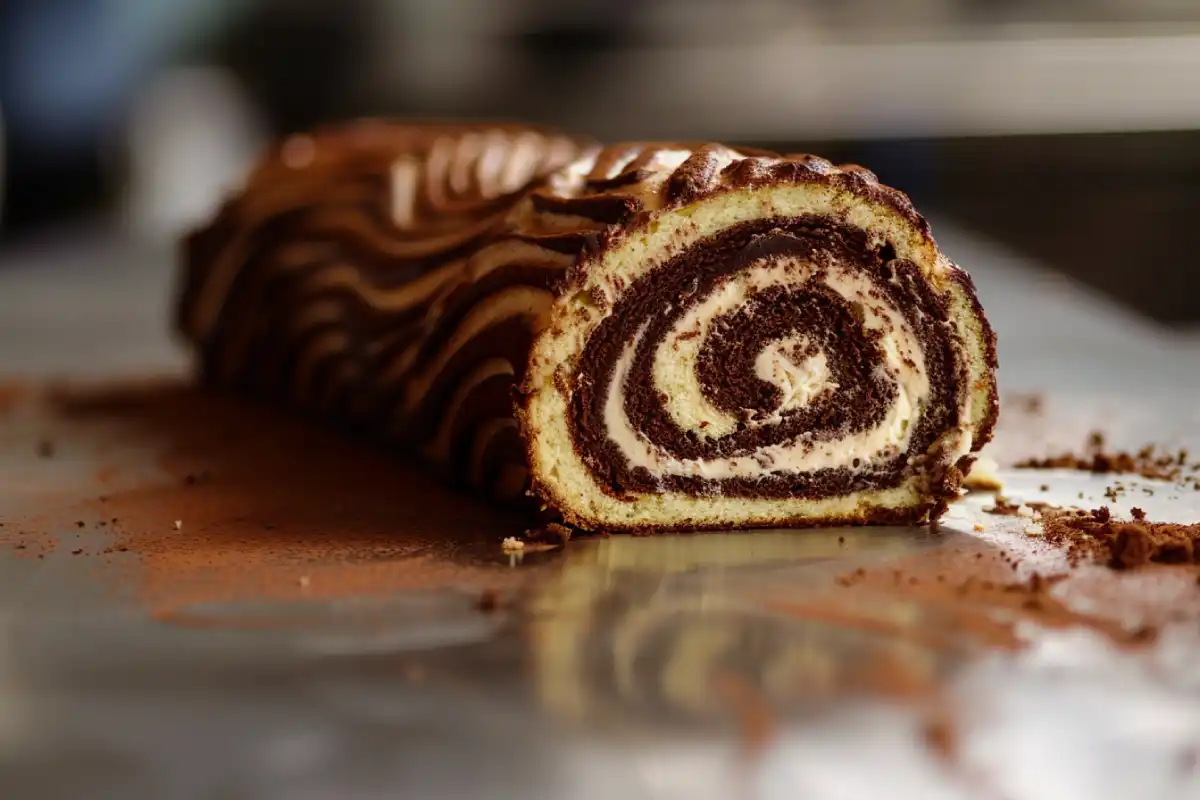
Vegan Yule Log Cake isn’t just some holiday dessert I make once a year—it kind of slipped into my life and stayed there, like one of those habits you don’t plan but somehow keep doing. Every December it shows up again, with its own… I don’t know, mood, I guess. Some years it’s easy, some years it’s dramatic. Most years it teaches me something I didn’t ask to learn.
And weirdly, that’s what I like about it.
It’s a soft roll of chocolate, patience, warmth… and a decent dose of unpredictability. Honestly, maybe that’s why I keep coming back to it.
table of contents
Table of Contents

Vegan Yule Log Cake: A Plant-Based Holiday Tradition With Heart
A tender vegan Yule log cake that rolls beautifully, holds its shape, and tastes rich, chocolatey, and festive. Made with aquafaba, oat milk, cocoa, and plant-based filling options, this holiday cake brings tradition, comfort, and emotion to the table — without dairy or eggs.
- Total Time: 45 minutes
- Yield: 10 slices 1x
Ingredients
1 cup all-purpose flour
1/3 cup unsweetened cocoa powder
3/4 cup fine sugar
1 teaspoon baking powder
1/4 teaspoon salt
1/3 cup neutral oil
3/4 cup oat milk
1/3 cup aquafaba (lightly whipped)
1 teaspoon vanilla extract
Vegan butter (for greasing)
Powdered sugar (for dusting)
FILLING OPTIONS:
Vegan chocolate ganache (plant cream + dark chocolate)
OR vanilla coconut whip
OR espresso-maple cream
Optional flavor add-ins: orange zest, hazelnut spread, cinnamon, espresso
Instructions
1. Preheat oven to 345°F (175°C). Line a 10×15 jelly roll pan with parchment and lightly grease.
2. In a bowl, whisk flour, cocoa powder, sugar, baking powder, and salt.
3. Separately whisk oat milk, oil, vanilla, and lightly whipped aquafaba.
4. Combine wet and dry ingredients, mixing until just smooth. Do not overmix.
5. Spread batter evenly in the pan with an offset spatula.
6. Bake 12–14 minutes until sponge springs back lightly.
7. While warm, flip cake onto parchment, peel off the backing, and roll immediately. Let cool completely while rolled.
8. Prepare your vegan filling of choice (ganache, coconut whip, espresso-maple cream, or hazelnut swirl).
9. Unroll cooled cake gently, spread an even layer of filling, leaving small borders.
10. Roll back up firmly but gently. Trim ends if needed.
11. Frost or dust with cocoa or powdered sugar. Add optional décor like cranberries, rosemary, or chocolate shavings.
Notes
Roll the sponge while warm — this is the key to avoiding cracks.
If the ganache is too thin, chill 10 minutes. Too thick? Warm slightly.
Add flavors like orange zest, espresso, or hazelnut to change the cake’s personality.
For gluten-free: use a 1:1 GF blend.
You can freeze the rolled cake (unfrosted) for up to 2 months.
Let the cake rest at least 30 minutes before slicing for clean spirals.
If your sponge cracks slightly, frosting covers everything — not a problem.
- Prep Time: 25 minutes
- Cook Time: 14 minutes
- Category: Dessert
- Method: Baking
- Cuisine: French
- Diet: Vegan
Nutrition
- Serving Size: 1 slice
- Calories: 280
- Sugar: 24g
- Sodium: 160mg
- Fat: 12g
- Saturated Fat: 5g
- Unsaturated Fat: 6g
- Trans Fat: 0g
- Carbohydrates: 39g
- Fiber: 3g
- Protein: 3g
- Cholesterol: 0mg
Understanding the Vegan Yule Log Tradition (Through the Lens of My Life in New Orleans)
The first time I came across the whole “Yule log cake” idea, I was living in New Orleans, and honestly… nothing about my surroundings said winter or log or anything remotely snowy. December there feels more like someone turned the thermostat down from “hot” to “warm-but-still-sweaty.” You get a breeze, sure, but nothing that makes you think of forests or fireplaces.
I remember walking past a little bakery near Magazine Street—one of those places that always smells like butter even when you’re not hungry—and seeing this rolled cake in the display. I didn’t know what it was. I thought maybe it was a jelly roll that got too fancy. I walked in, asked the baker, and he said, “Oh honey, that’s a bûche de Noël,” like I was supposed to instantly understand centuries of French tradition.
I didn’t.
Not even a little.
New Orleans is the kind of place where traditions don’t stand alone—they overlap, bump shoulders, mix together like jazz notes in a song that nobody rehearsed. You hear brass instruments from a block away, someone frying shrimp two houses down, and a stranger laughing on a porch you’ve never been to. Winter in this city is… alive. Not quiet. Not gentle. Definitely not snowy.
So there I was, learning about this very French ritual in a place that couldn’t be more different. A dessert shaped like a log? Rolled up like a tiny carpet? Frosted to look like bark? It sounded like something out of a storybook. And also kind of adorable.
But when the baker explained what it symbolized—warmth in the darker months, resilience, gathering around something sweet and comforting—I felt myself leaning in. I didn’t grow up with this tradition at all, but something about it clicked in my chest.
Maybe it was the idea of creating a dessert that feels like a hug.
Maybe it was the drama of the rolling (I love a little drama).
Or maybe it was simply the idea that a cake could carry meaning without saying a word.
I started reading more about it that night, sitting at my little kitchen table with a cup of chicory coffee that had gone cold because I got too distracted. I learned that families used to burn an actual log during winter celebrations—something symbolic, something protective. And over time, that log became a cake. A sweet one. A shared one.
I loved that.
How traditions shift but still survive.
But when I saw the ingredients—eggs, butter, cream—I felt a pinch of doubt. Could a Vegan Yule Log Cake really hold the same emotion? The same physics, even? Would it roll? Would it tear? Would it just… collapse like a tired December mood?
Something in me, though—some stubborn, curious part—said:
“Try anyway.”
And that’s how I ended up chasing this plant-based version through several winters, making mistakes that made me laugh (and occasionally swear), until eventually, the vegan version didn’t just work.
It felt true.
It felt like its own tradition, not a copy of another.
And strangely enough, it fit New Orleans better than the original ever did.
Ingredients That Make a Plant-Based Log Actually Roll (And Roll Well)
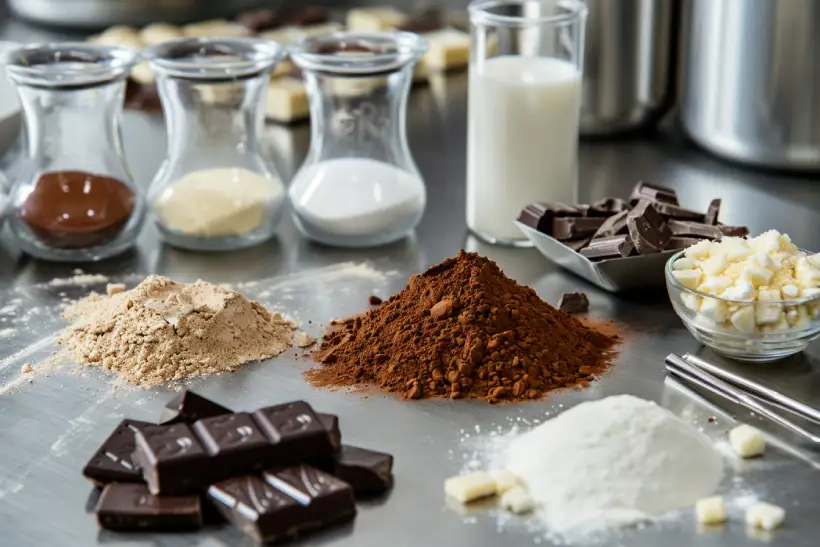
A rolled cake is a soft creature. Sensitive. Emotional. It refuses to behave if you treat it carelessly. But when you understand what each ingredient offers, the whole dessert becomes a conversation rather than a battle.
The Dry Foundation
- All-purpose flour
- Unsweetened cocoa powder (the darker the better—trust me)
- Fine sugar
- Baking powder (fresh!)
- A little salt
These are simple, predictable, steady. They behave like old friends.
What Makes It Vegan & Rollable
Here’s where the magic happens:
- Aquafaba → gives structure and elasticity
- Oat milk → creates tenderness and moisture
- Neutral oil → prevents cracking
- Vegan butter → adds richness so the sponge tastes like dessert, not compromise
Without this combination, your Vegan Yule Log Cake won’t roll—it will rebel.
Filling Options That Change Everything
You can use:
- Silky chocolate ganache (made with plant cream)
- Espresso-maple cream
- Vanilla coconut whip
- Hazelnut chocolate filling
- Orange zest cream
Each version changes the character. Each version tells a different story.
Gluten-Free, Nut-Free, Soy-Free Realities
People often think vegan AND allergen-friendly is impossible.
But:
- A 1:1 gluten-free blend rolls beautifully
- Oat milk replaces nut-based milks easily
- Coconut cream or soy-free whipping cream fixes dairy issues
A festive dessert should never exclude anyone.
The Steps I Learned the Hard Way (With Burnt Fingers & Broken Rolls)
I’m going to be honest: learning how to make the perfect Vegan Yule Log Cake took patience I didn’t know I had. I failed so many times it became a running joke in my kitchen. But each failure taught me something essential.
1. Mix Like You Mean It (But Not Too Much)
Mixing is like starting a conversation—you don’t shout, you don’t mumble. You keep the tone soft, steady, and intentional. Overmixing makes a tough sponge. Undermixing leaves lumps that taste like regret.
2. Spread the Batter Evenly
This is the step people skip.
Don’t skip it.
Your rolling future depends on it.
Use an offset spatula. Breathe. Smooth it until the surface looks like a quiet lake.
3. Bake at 345°F
Yes, 345°F.
Not 350°F—my oven runs hot, and many ovens do. This temperature keeps the sponge soft enough to roll without crying about it later.
4. Roll While It’s Warm
This is the sacred moment.
When that timer beeps:
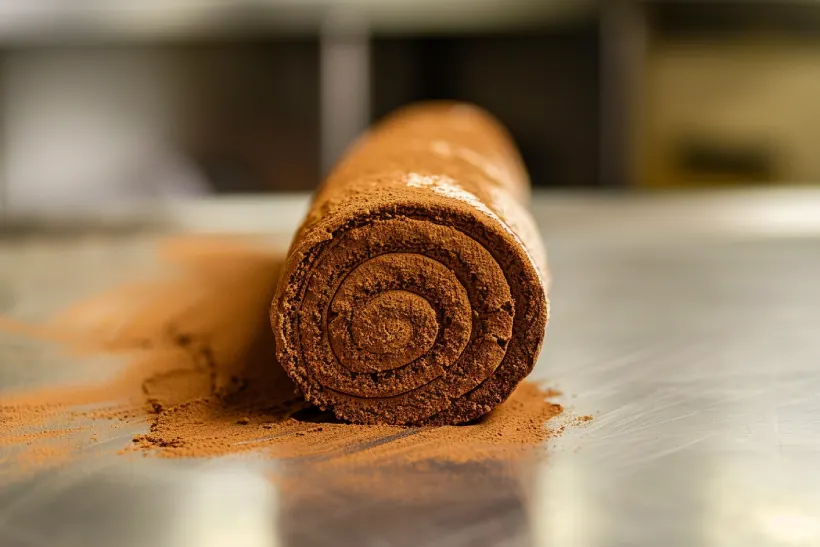
- Lift sponge
- Flip onto parchment
- Roll NOW
If you wait even 3 minutes too long, it cracks.
If you wait 10 minutes… well, it becomes a chocolate plank.
And yes, I learned this the hard way.
5. Fill Like You’re Spreading Softness
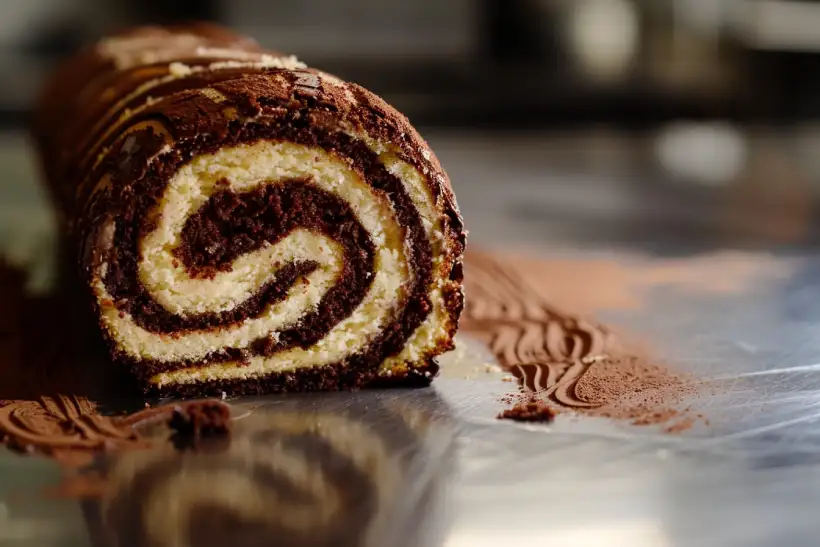
Don’t bombard the cake with frosting.
Let it breathe.
Spread gently, leave borders.
Too much filling = slippery chaos.
6. Roll Again With Confidence

Here’s the part where you’ll question everything.
Roll from the short end, slowly, firmly, but lovingly.
Like wrapping a fragile memory.The Night Everything Went Wrong (And Why It Made Me Better)
One December evening, I tried to make a Vegan Yule Log Cake after a long day. I shouldn’t have. My body was tired, my mind scattered. But I insisted—holidays make us do stubborn things.
I poured the batter too quickly.
I spread it unevenly.
The sponge overbaked.
The roll cracked like it had lost patience with me.
The ganache split because I rushed it.
And something in me cracked too.
I turned off the lights, sat on the kitchen floor, and let the sound of New Orleans night wrap around me—the distant brass, the chatter of neighbors, the hum of a passing streetcar.
Then I got up.
Lit a candle.
Started again.
This time slowly.
Softly.
Gently.
The second cake rolled perfectly.
I tell you this because people think baking is precision only. But it’s more than that. It’s emotion. Intuition. Breath. Presence.
A Vegan Yule Log Cake listens to your mood.
It teaches you as much as you teach it.
Flavors That Took Me by Surprise (And Might Surprise You Too)
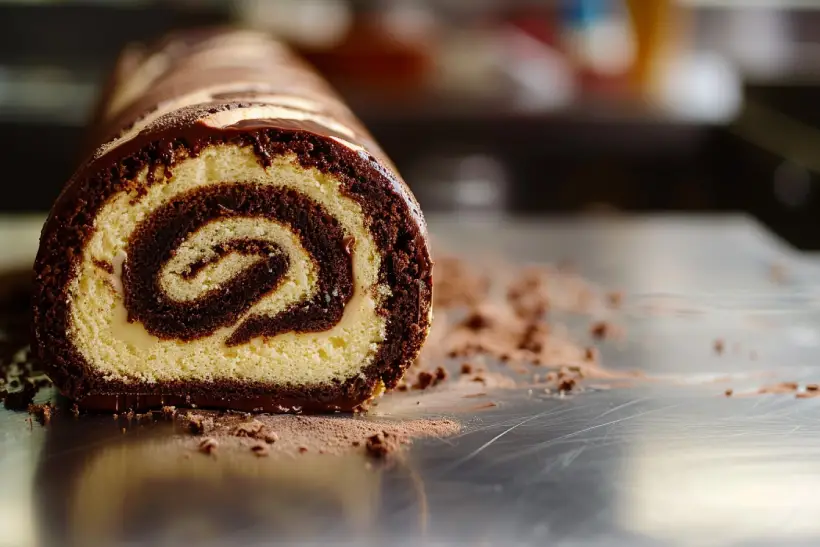
The beauty of a plant-based recipe is how adaptable it is. Once you master the base, a whole world opens.
Chocolate Espresso
Bold, mature, indulgent.
Vanilla Bean & Orange Zest
Bright, fragrant, nostalgic.
Matcha Cream
Earthy, poetic, unexpected.
Hazelnut Swirl
Rich, soft, unforgettable.
Spiced Maple
Warm, comforting, perfect for winter evenings.
Each version still embodies the soul of a Vegan Yule Log Cake—tender, rolled, generous.
When Things Go Wrong (Because They Will)
Cracks in the Roll
- Rolled too late
- Too little oil
- Sponge overbaked
Dry Texture
- Add 1–2 tbsp more oat milk next time
- Reduce oven time by 2 minutes
Ganache Too Soft
- Chill 10 minutes
- Add more chocolate
Flat Roll
- Batter wasn’t spread evenly
- Aquafaba was underwhipped
Everything is fixable.
Everything.
Decoration: Minimalist or Magical, Your Choice
You can go simple:
- Cocoa dusting
- Powdered sugar “snow”
- A smooth frosting
- Clean lines
Or dramatic:
- Bark-like lines made with a fork
- Cranberries that glisten
- Rosemary sprigs as “branches”
- Chocolate shards
- Little mushrooms made of meringue (vegan, of course)
A Vegan Yule Log Cake wears any style gracefully.
Make-Ahead Tips for a Stress-Free December
- Sponge keeps 1 day wrapped in parchment
- Fully rolled (unfrosted) cake freezes 2 months
- Frosting + decorating is best done same day
- Thaw overnight in the refrigerator
This dessert is surprisingly travel-friendly once rolled.
If you love pairing warm drinks with something sweet, my Vegan Yule Log Cake fits perfectly next to this coffee and hot chocolate mix — cozy, festive, and made for winter evenings.
FAQ About Vegan Yule Log Cake (The Questions I Hear Every Year)
How do you make it step by step?
Bake → Roll warm → Unroll → Fill → Roll → Frost.
What ingredients do you need?
Flour, cocoa, sugar, plant milk, aquafaba, oil, vegan butter.
Can it be gluten-free?
Yes. Use a 1:1 gluten-free blend.
How far ahead can you prepare it?
Sponge: 1 day.
Frosting: same day.
Freeze: 2 months.
Decoration ideas?
Powdered sugar, bark texture, cranberries, rosemary.
Flavor variations?
Espresso, matcha, maple spice, hazelnut.
What Real People Said About the Vegan Yule Log Cake
Jasmine R. — Austin, Texas
“Amara, I honestly didn’t expect it to turn out that good. The Vegan Yule Log Cake came out soft and the texture surprised everyone. My sister asked me twice if it was really vegan. I had a small crack when I rolled it, but it still tasted amazing. I’m making it again for Christmas Eve.”
Elliot M. — Baltimore, Maryland
“I tried your Vegan Yule Log Cake last weekend. The smell filled the house and my family walked into the kitchen before I even called them. My roll wasn’t perfect and it cracked on one side, but the taste felt warm and familiar. Almost nostalgic. It really made the evening.”
Why This Cake Speaks to My Multicultural Heart
In New Orleans, cultures don’t just coexist—they dance together. French, Creole, African, Southern. This dessert feels like that dance.
It combines:
- French tradition
- Plant-based innovation
- Warm Southern energy
- Personal emotion
- A touch of chaos and charm
Every year, I bake this Vegan Yule Log Cake not just to serve dessert, but to honor memory, patience, transformation, and the sweetness of shared celebration.
It’s imperfect.
It’s emotional.
It’s delicious.
And it feels like home.


Looks amazing. But the photo shows a yellow cake; wouldn’t this be a chocolate sponge, based on the photo?
Great question — and you’re right to notice the contrast 😊
This yule log uses a chocolate sponge made with cocoa powder, not melted chocolate. When cocoa is used (especially in a thin rolled sponge), the cake can bake up lighter in color, especially under bright lighting or after being rolled with a pale filling.
The flavor is fully chocolate, even if the visual tone looks lighter in the swirl.
If you have any other questions, feel free to ask — I’m always happy to help.