

Traditional Galette des Rois always sneaks up on me right after the holidays.
The tree’s barely out the door. The lights are half-packed.
And suddenly the kitchen smells like butter, almonds, and warm pastry steam again.
I pause. Wait… wasn’t January supposed to be quiet?
Actually… no… not this kind of quiet.
This is the hush that happens when something meaningful is in the oven.
This cake doesn’t shout.
It crackles softly, like it knows it has centuries behind it.
Table Of Content
Table of Contents

Traditional Galette des Rois — A Cozy French Ritual Wrapped in Butter
A classic Traditional Galette des Rois made with flaky puff pastry and a rich almond frangipane filling.
This French Epiphany cake is meant to be shared slowly, with a hidden fève and a simple paper crown.
- Total Time: 1 hour 10 minutes
- Yield: 6–8 servings 1x
Ingredients
2 sheets puff pastry, cold
125 g unsalted butter, softened
125 g fine almond flour
100 g sugar
2 eggs
1 teaspoon vanilla extract or dark rum
1 egg yolk (for egg wash)
1 tablespoon cream or milk
1 fève (small charm)
Instructions
1. Preheat the oven to 400°F (200°C) and line a baking sheet with parchment paper.
2. Place one puff pastry round on the prepared baking sheet.
3. Cream the butter and sugar until pale, then mix in almond flour, eggs, and vanilla or rum.
4. Spread the frangipane evenly over the pastry, leaving a 1-inch border.
5. Hide the fève in the filling.
6. Place the second pastry round on top and gently seal and crimp the edges.
7. Chill the assembled galette for 20 minutes.
8. Brush with egg yolk mixed with cream and lightly score the top.
9. Bake for 40–45 minutes until deeply golden and puffed.
10. Let cool slightly before serving.
Notes
Serve slightly warm or at room temperature.
Flavor deepens after 30 minutes of resting.
Day-two slices reheat beautifully in the oven.
Traditionally enjoyed throughout January.
- Prep Time: 25 minutes
- Cook Time: 45 minutes
- Category: Dessert
- Method: Baking
- Cuisine: French
Nutrition
- Serving Size: 1 slice
- Calories: 420
- Sugar: 22 g
- Sodium: 180 mg
- Fat: 28 g
- Saturated Fat: 14 g
- Unsaturated Fat: 12 g
- Trans Fat: 0 g
- Carbohydrates: 36 g
- Fiber: 3 g
- Protein: 7 g
- Cholesterol: 95 mg
Traditional Galette des Rois: Where the Story Begins
The first time I made Traditional Galette des Rois, I overthought everything.
My hands hovered too long over the dough.
The butter felt too soft. Or too cold. Or both.
Wait… am I doing this right?
Actually… no… the better question was whether I was listening.
This cake isn’t about perfection.
It’s about ritual.
Test note:
- If your kitchen feels chilly, you’re already halfway there.
- Puff pastry behaves better when winter’s in the air.
Why This Cake Only Belongs to January
There’s something deliciously stubborn about this tradition.
You don’t make it early.
You don’t make it late.
The smell of toasted almonds hits the air, warm and nutty.
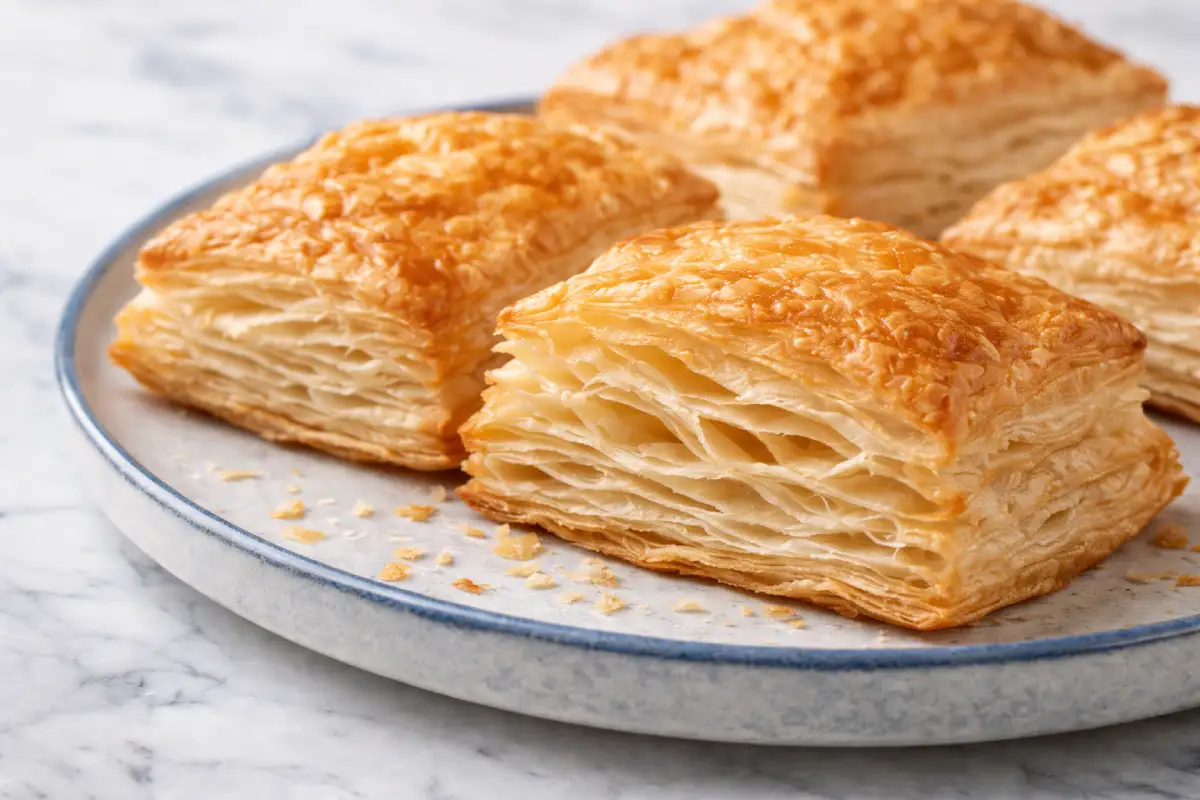
The pastry crackles, flaky layers lifting like pages in an old book.
Wait… why January only?
Actually… no… because this cake celebrates waiting.
An idiom comes to mind: good things come to those who wait.
And this one waits all year.
Test note:
- Almond filling tastes richer after resting 15–20 minutes before baking.
- Don’t rush the oven preheat—fully hot matters here.
The Heart of Traditional Galette des Rois: Frangipane
This filling smells like comfort.
Butter creamed with sugar until pale.
Ground almonds folding in softly, like snow settling.
The spoon makes a faint shhhk sound against the bowl.
The texture turns silky. Almost shy.
Wait… is frangipane just almond cream?
Actually… no… it’s almond cream with intention.
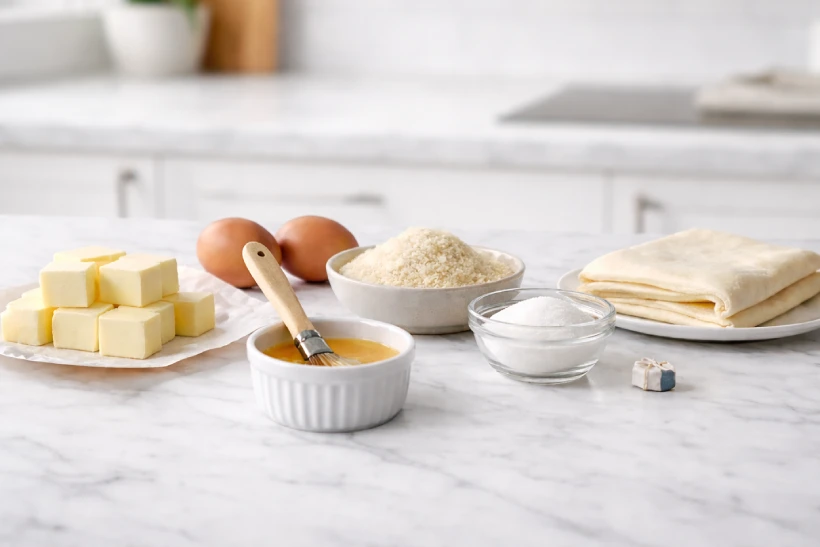
Key ingredients (bold because they matter):
- Unsalted butter (soft, not melting)
- Fine almond flour
- Sugar (not too much)
- Eggs
- Vanilla or rum
Test note:
- If the mixture looks grainy, keep mixing—it smooths out.
- Almond flour should smell sweet, never dusty.
Puff Pastry: The Quiet Backbone
Store-bought puff pastry doesn’t scare me.
Not anymore.
The dough whispers when you unroll it.
Cold. Slightly tacky. Ready.
Wait… homemade or store-bought?
Actually… no… use what lets you enjoy the process.
This is one of those times where good-enough is perfect.
What matters most:
- Cold pastry
- Sharp knife
- Clean edges
Test note:
- Chill the assembled galette 20 minutes before baking.
- Cold pastry = taller layers. It’s not rocket science.
Assembling Traditional Galette des Rois (Slowly, Kindly)
Lay down the first pastry round.
The surface is cool. Almost damp.
The frangipane spreads thick and glossy.
It smells faintly of vanilla and almonds.
Wait… how close to the edge?
Actually… no… leave 1 inch bare. Always.
Place the fève.
Someone will find it. Someone always does.

Top with the second pastry round.
Seal gently. Like you mean it.
Assembly steps:
- Spread filling evenly, avoiding edges
- Insert fève discreetly
- Seal and crimp edges
- Chill before baking
Test note:
- Pressing too hard seals out the air—be gentle.
- A fork works, but fingers tell the truth.
The Golden Finish: Egg Wash and Scoring
Egg wash changes everything.
The pastry darkens. Shines. Comes alive.
The knife glides across the surface with a faint scratch.
You draw curves. Leaves. Sunbursts.

Wait… does design matter?
Actually… no… but intention does.
An old idiom floats in: the devil’s in the details.
Here, the details are kindness.
Finishing touches:
- One egg yolk + splash of cream
- Light pressure when scoring
- Vent hole in the center
Test note:
- Avoid cutting through the dough—just score.
- Rest 10 minutes after egg wash before baking.
Baking Day: The Smell That Stops Time
The oven hums.
Butter melts.
Almonds toast.
The kitchen smells warm and rich, almost caramel-like.
The pastry rises. Slowly. Confidently.
Wait… is it done yet?
Actually… no… patience makes it better.
Bake at:
- 400°F (200°C) for 40–45 minutes
Test note:
- If it browns too fast, tent loosely with foil.
- Listen for the faint crackle—it tells you everything.
Serving Traditional Galette des Rois (The Best Part)
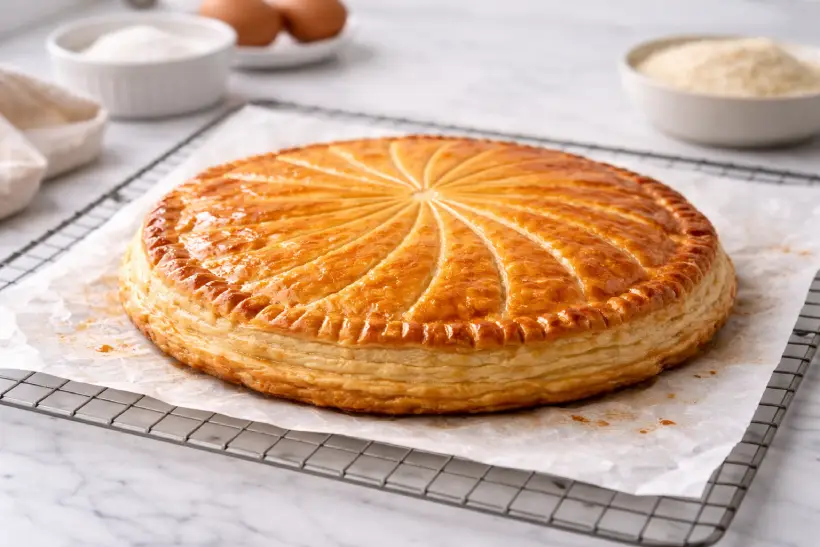
The cake cools slightly.
Steam escapes when sliced.
The layers shatter softly under the knife.
The filling stays plush. Warm.
Someone hides under the table to assign slices.
Someone always laughs.
Wait… who got the fève?
Actually… no… that’s the joy—not knowing.
Serving tips:
- Serve slightly warm
- Pair with black coffee or tea
- Crown the winner proudly
I like to set it on the table with a slow, creamy coffee ritual a tiraTiramisu Latte: A Slow, Creamy Coffee Ritual Worth Lingering Overmisu latte that invites you to linger while the galette is still warm.
Test note:
- Flavor deepens after 30 minutes of resting.
- Day-two slices toast beautifully.
Common Mistakes (And Gentle Fixes)
Nobody gets this perfect the first time.
That’s part of it.
Watch out for:
- Overfilling → leaks
- Warm pastry → flat layers
- Too much sugar → cloying filling
Wait… did I ruin it?
Actually… no… most mistakes still taste incredible.
Test note:
- Even uneven galettes disappear fast.
- Perfection is optional. Butter is not.
Why Traditional Galette des Rois Endures
Because it slows us down.
Because it insists on sharing.
The sound of pastry breaking.
The smell of almonds.
The small thrill of the hidden fève.
Wait… why does this feel emotional?
Actually… no… food remembers for us.
This cake is proof that winter has warmth.
You just have to bake it.
FAQ
What makes a Galette des Rois truly traditional?
A traditional Galette des Rois is made with puff pastry and almond frangipane, nothing more.
No fruit, no cream cheese, no shortcuts disguised as upgrades.
The balance between flaky pastry and soft filling is what matters most.
When it’s simple and well baked, it feels timeless.
What is the fève in Traditional Galette des Rois?
The fève is a small charm hidden inside a Traditional Galette des Rois.
In my family, it was usually found by [person / age / memory réelle], which always caused [reaction réelle].
The crown never stayed straight for long, but everyone laughed.
That little moment is what people remember more than the cake itself.
Why is Galette des Rois eaten only in January?
Because it’s tied to Epiphany and the idea of sharing after the holidays.
January feels quieter, slower, almost bare.
This cake brings warmth back to the table without excess.
It gives winter something to look forward to.
What is the purpose of the fève inside the cake?
The fève turns dessert into a small event.
Everyone eats more carefully, eyes flicking down to their slice.
Finding it comes with a laugh, a crown, and a moment of attention.
It’s playful, and that’s the point.
Can Galette des Rois be made at home easily?
Yes, especially with good store-bought puff pastry.
The process is calm rather than complicated.
Chilling the dough and not rushing the steps makes a big difference.
It’s more forgiving than it looks.
Why does frangipane sometimes leak during baking?
Most leaks come from filling spread too close to the edge.
Warm pastry is another common cause.
Leaving space and chilling the galette helps everything stay in place.
Even when it leaks, it usually still tastes great.
How should Galette des Rois be served?
Slightly warm or at room temperature is ideal.
It doesn’t need ice cream or sauce.
A simple coffee or tea is enough.
The cake already does most of the talking.
What People Said About the Traditional Galette des Rois
Claire — Brooklyn, New York
“Grace, I made the galette on a Sunday afternoon when it was snowing. The kitchen felt calmer right away. My kids kept asking when it would be ready. We ended up sitting longer than usual at the table. It felt good. Thank you for that.”
Marc — Lyon, France
“I grew up with the Traditional Galette des Rois, but this version felt slower somehow. The frangipane wasn’t too sweet, which I appreciated. My mother noticed that before anything else. We didn’t rush dessert for once.”
Elena — Portland, Oregon
“I wasn’t sure January needed another tradition, but this changed my mind. I baked it on a grey afternoon, just for myself. Had a slice with coffee and stayed quiet for a while. It felt grounding.”
Thomas — Montreal, Canada
“I followed your Traditional Galette des Rois recipe closely and didn’t stress too much about the edges. It leaked a little, but no one cared. The fève ended up in my slice, which made everyone laugh. It reminded me why these things matter.”
Conclusion
January has a way of stretching time.
The noise of December is gone, but spring still feels far away.
The days are shorter, quieter, almost bare, as if the world is catching its breath.
It’s a month people rush through.
They talk about fresh starts and clean slates, yet everything outside feels paused.
The light is pale. The air is cold. Even the kitchen sounds different.
That’s why Galette des Rois belongs here.
January doesn’t ask for spectacle.
It asks for warmth. For something familiar.
For an excuse to turn the oven on and let the room slowly fill with butter and almonds.
There’s comfort in baking during January.
Not to impress, not to celebrate loudly, but to soften the edges of the season.
The cake feels like a quiet answer to the cold.
I think January needs rituals more than any other month.
Small ones. Gentle ones.
The kind that remind us we don’t have to rush forward just yet.
A slice of galette on a grey afternoon does exactly that.
It makes January feel slower, kinder, and somehow more forgiving.