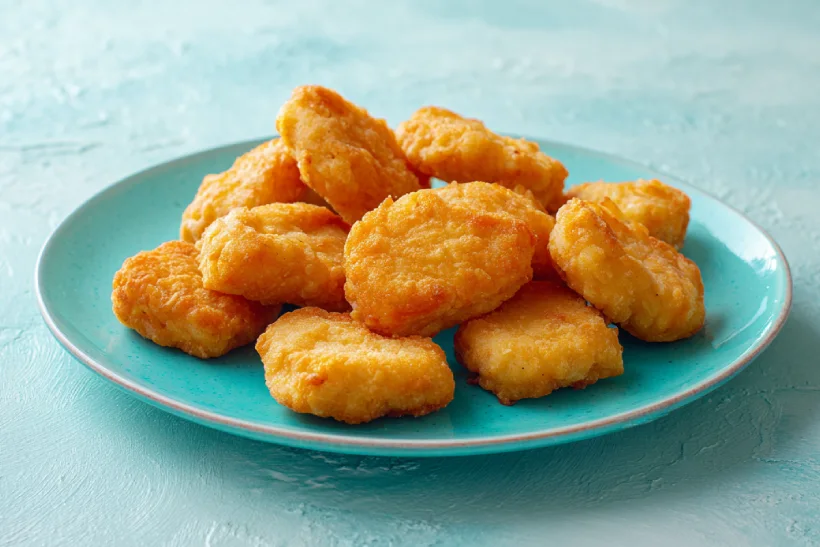

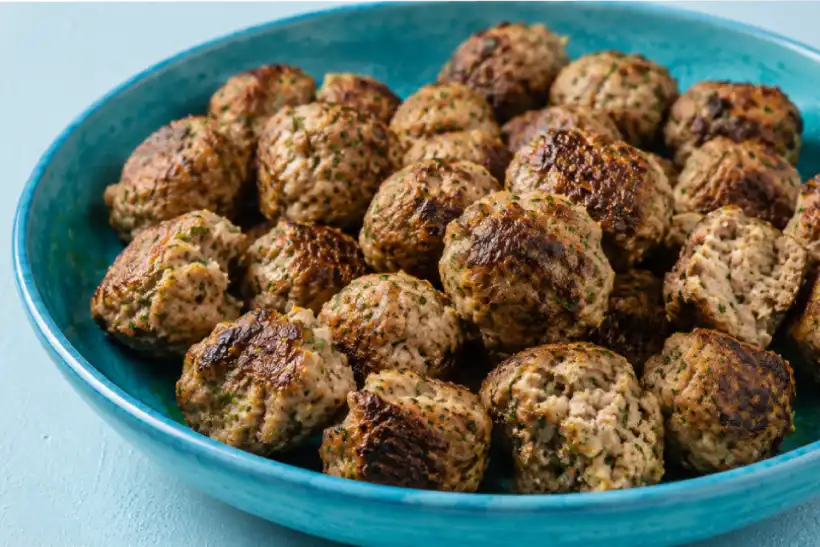
Bariatric chicken meatballs are tender, moist, high in protein, and easy to portion into small servings for meal prep. Finely grated zucchini and Greek yogurt protect the lean ground chicken from drying out, while egg and Parmesan provide enough structure to make the recipe without traditional breadcrumbs.
Each batch makes 20 mini baked meatballs. One four-meatball serving provides an estimated 22 grams of protein, and each meatball contains about 5.4 grams. Those numbers make it easier to adjust the portion to your individual meal capacity and protein target.
This recipe may fit a bariatric eating plan after ground poultry has been approved by your bariatric care team. Postoperative stages, texture requirements, and individual tolerance vary, so a soft meatball is not automatically appropriate for every person or every stage.
Table Of Contents
Table of Contents

Bariatric Chicken Meatballs That Stay Tender
Tender bariatric chicken meatballs made with ground chicken, finely grated zucchini, Greek yogurt, egg, and Parmesan. These baked mini meatballs contain no traditional breadcrumbs and provide approximately 22 grams of protein per four-meatball serving.
- Total Time: 34–37 minutes
- Yield: 20 mini meatballs 1x
Ingredients
Nonstick cooking spray
1 pound ground chicken, preferably about 92%–93% lean
1/2 cup finely grated zucchini, about 2 ounces or 60 grams, lightly squeezed
1 large egg, lightly beaten
1/3 cup finely grated Parmesan cheese, about 1 ounce or 28 grams
2 tablespoons plain Greek yogurt, nonfat or 2%
1 teaspoon Italian seasoning
1/2 teaspoon garlic powder
1/2 teaspoon onion powder
1/4 teaspoon fine sea salt
1/4 teaspoon ground black pepper
Instructions
1. Preheat the oven to 400°F (204°C). Line a rimmed baking sheet with parchment paper and coat it lightly with nonstick cooking spray.
2. Finely grate the zucchini. Press it gently in a clean kitchen towel or paper towels until it no longer drips but remains slightly moist.
3. In a large mixing bowl, stir together the beaten egg, Parmesan, Greek yogurt, Italian seasoning, garlic powder, onion powder, salt, and black pepper.
4. Add the ground chicken and grated zucchini. Fold gently with a fork, flexible spatula, or clean hand only until the ingredients are evenly combined. Do not knead or overmix.
5. Use a one-tablespoon cookie scoop to divide the mixture into 20 portions. Lightly dampen your hands and gently shape each portion into a meatball about 1 to 1 1/4 inches wide.
6. Arrange the meatballs about 1 inch apart on the prepared baking sheet.
7. Bake for 14–17 minutes. Begin checking the largest meatball after 13–14 minutes.
8. Insert an instant-read thermometer through the side and into the center of a meatball. Remove the pan when every meatball has reached a minimum internal temperature of 165°F (74°C).
9. Let the meatballs rest on the baking sheet for 5 minutes before serving.
Notes
The raw mixture should feel soft and slightly tacky but still hold the shape of a one-tablespoon scoop.
Do not squeeze all the moisture from the zucchini. It should remain damp without dripping.
Ground chicken made only from chicken breast may produce drier meatballs. A blend containing some dark meat or about 7%–8% fat provides a more forgiving texture.
Avoid overmixing or firmly packing the meatballs, which can make the cooked texture dense or rubbery.
If the mixture is too soft to scoop, refrigerate it for 10 minutes before changing the ingredient quantities.
Use an instant-read thermometer. Ground poultry must reach a minimum internal temperature of 165°F (74°C).
Nutrition is estimated per serving of four mini meatballs and does not include sauce or side dishes.
Each meatball provides approximately 50 calories and 5.4 grams of protein.
Postoperative eating stages and individual tolerance vary. Follow the guidance of your bariatric surgeon or registered dietitian before adding this recipe to your meal plan.
For refrigerator storage, place cooled meatballs in an airtight container and use within 3–4 days.
To freeze, arrange cooled meatballs in a single layer until firm, then transfer them to a freezer-safe bag or container. For best quality, use within 3–4 months.
Reheat meatballs covered with low-sugar marinara, broth, or a small amount of water to reduce moisture loss. Reheated leftovers should reach 165°F (74°C).
For a gluten-free recipe, verify that the Parmesan, yogurt, seasonings, and cooking spray are certified gluten-free when cross-contact is a concern.
- Prep Time: 15 minutes
- Cook Time: 14–17 minutes
- Category: Main Course
- Method: Baking
- Cuisine: American
Nutrition
- Serving Size: 4 mini meatballs
- Calories: 200
- Sugar: Less than 1 g
- Sodium: 295 mg
- Fat: 12 g
- Saturated Fat: 4 g
- Carbohydrates: 1–2 g
- Fiber: Less than 1 g
- Protein: 22 g
- Cholesterol: 120 mg
Why These Bariatric Chicken Meatballs Work
Protein is easy to track
Ground chicken, egg, Parmesan, and Greek yogurt contribute protein without requiring a large serving. Four mini meatballs provide an estimated 22 grams of protein, while a smaller two-meatball portion provides about 11 grams.
Protein needs after bariatric surgery are individualized. The American Society for Metabolic and Bariatric Surgery notes that many bariatric programs recommend 60 to 100 grams of protein per day, depending on the patient.
The mini format matters here. Instead of estimating how much of a large meatball you ate, you can count whole pieces and match the serving to your approved plan.
The texture stays soft without becoming loose
Ground chicken can turn firm and dry when it is very lean, heavily mixed, or cooked past its safe temperature. This formula addresses all three issues.
Finely grated zucchini releases moisture as the meatballs bake. Greek yogurt supplies additional water and a small amount of fat, while Parmesan and egg bind the mixture. The result should be soft and springy rather than rubbery or crumbly.
A softer raw mixture is not automatically a failed mixture. It should feel slightly tacky and hold a rounded one-tablespoon mound, but it will not feel as stiff as a breadcrumb-heavy beef meatball mixture.
No traditional breadcrumbs are required
Egg proteins set during cooking, and finely grated Parmesan reinforces that structure. That allows these bariatric chicken meatballs to hold together without panko, bread crumbs, oats, or flour.
The base recipe is naturally low in carbohydrates. It can also be gluten-free when the Parmesan, yogurt, seasonings, and cooking spray are verified gluten-free and cross-contact is avoided.
Equipment
Use a rimmed baking sheet, parchment paper, fine grater, large mixing bowl, flexible spatula or fork, one-tablespoon cookie scoop, and instant-read thermometer.
The scoop is more than a convenience. Equal portions reach the safe temperature at approximately the same time, reducing the chance that smaller meatballs dry out while larger ones finish cooking.
Ingredients for Bariatric Chicken Meatballs

- Nonstick cooking spray
- 1 pound ground chicken, preferably about 92%–93% lean
- 1/2 cup finely grated zucchini, about 2 ounces or 60 grams, lightly squeezed
- 1 large egg, lightly beaten
- 1/3 cup finely grated Parmesan cheese, about 1 ounce or 28 grams
- 2 tablespoons plain Greek yogurt, nonfat or 2%
- 1 teaspoon Italian seasoning
- 1/2 teaspoon garlic powder
- 1/2 teaspoon onion powder
- 1/4 teaspoon fine sea salt
- 1/4 teaspoon ground black pepper
Choose ground chicken with some fat
Check the package rather than assuming all ground chicken is equally lean. A product made only from chicken breast may cook drier than one containing both light and dark meat.
Ground chicken around 92%–93% lean gives the recipe a little more protection against dryness without making the meatballs greasy. Ground turkey can be substituted, but the same rule applies: extremely lean poultry leaves less room for cooking error.
Keep some moisture in the zucchini
Grate the zucchini on the fine holes of a box grater. Fine strands distribute more evenly than coarse shreds and are less noticeable in the cooked meatballs.
Press the zucchini gently in a clean kitchen towel or several layers of paper towel. It should feel damp and fluffy, with no liquid dripping from it. Do not twist it into a completely dry clump. That sounds minor, but the retained water helps produce tender chicken meatballs.
Build structure with egg and Parmesan
The egg binds the chicken as its proteins coagulate in the oven. Parmesan adds another layer of structure along with protein, saltiness, and savory flavor.
Use finely grated Parmesan rather than long, coarse shreds. Fine cheese disperses throughout the mixture instead of leaving pockets that can melt away from the meat.
Add moisture with plain Greek yogurt
Two tablespoons soften the mixture without making it soupy. Use plain, unsweetened yogurt. Flavored yogurt would change the taste, sugar content, and carbohydrate estimate.
Nonfat yogurt works, although 2% yogurt gives the meatballs a slightly richer mouthfeel. The measured amount is small enough that either option works without altering the shaping method.
How to Make Bariatric Chicken Meatballs
1. Heat the oven
Preheat the oven to 400°F / 204°C. Line a rimmed baking sheet with parchment paper and coat it lightly with nonstick cooking spray.
Allow the oven to preheat fully before baking. Starting in a cooler oven can lengthen the cooking time and reduce surface browning.
2. Prepare the zucchini
Finely grate the zucchini. Press it gently in a towel until it no longer drips but remains visibly moist.
Measure the zucchini after grating. A firmly packed half cup carries more moisture and vegetable matter than a loosely filled cup, which can make the mixture too wet.
3. Mix the binder first
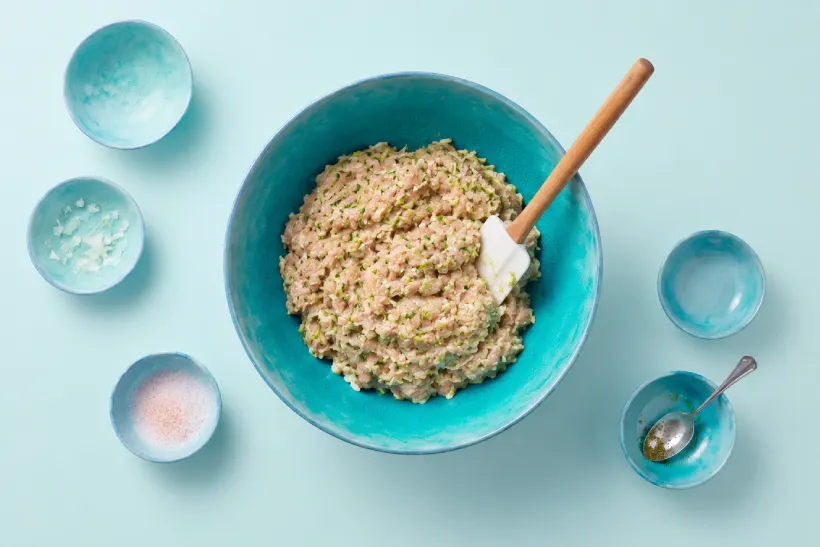
In a large bowl, stir together the beaten egg, Parmesan, Greek yogurt, Italian seasoning, garlic powder, onion powder, salt, and black pepper.
Combining these ingredients before adding the meat distributes the seasonings and binder with less handling. Ground chicken becomes denser as it is repeatedly stirred and compressed.
4. Fold in the chicken and zucchini
Add the ground chicken and grated zucchini. Use a fork, flexible spatula, or clean hand to fold the mixture only until the ingredients are evenly distributed.
Stop as soon as there are no obvious streaks of egg or yogurt. Do not knead, squeeze, or repeatedly mash the mixture against the bowl.
The finished mixture should look soft and slightly glossy. A one-tablespoon scoop should hold its shape on the baking sheet, although the mound may relax slightly at the base.
5. Portion the mini meatballs

Use a one-tablespoon cookie scoop to divide the mixture into 20 portions. Lightly dampen your hands and roll each portion with minimal pressure.
Aim for meatballs about 1 to 1 1/4 inches wide. Arrange them roughly 1 inch apart on the prepared baking sheet.
Do not pack the meat tightly to create a perfectly smooth ball. Gentle shaping leaves a more tender interior.
6. Bake and check the temperature early
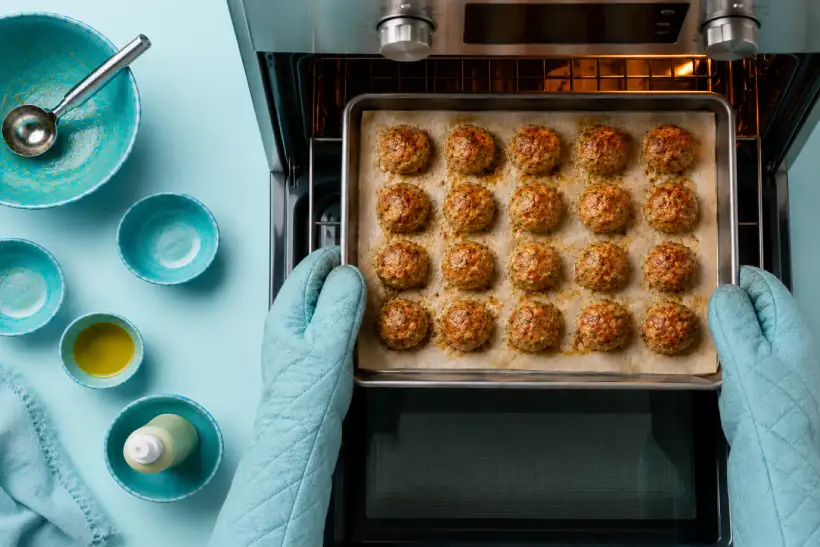
Bake for 14–17 minutes. Begin checking the largest meatball around the 13- or 14-minute mark.
According to the USDA Food Safety and Inspection Service, ground poultry must reach a minimum internal temperature of 165°F / 74°C, measured with a food thermometer; surface color alone cannot confirm safety. Ground poultry must reach a minimum internal temperature of 165°F / 74°C; cooking time and surface color alone cannot confirm safety.
The surface may be pale golden rather than deeply browned when the center is ready. Remove the pan once the largest meatballs reach 165°F instead of leaving them in the oven for additional color.
7. Rest briefly
Let the meatballs rest on the pan for 5 minutes. They will firm slightly as the egg and cheese finish setting.
Serve them whole only when that size and texture have been approved for you. Otherwise, cut them into small bites, chew thoroughly, and eat slowly according to your care team’s instructions.
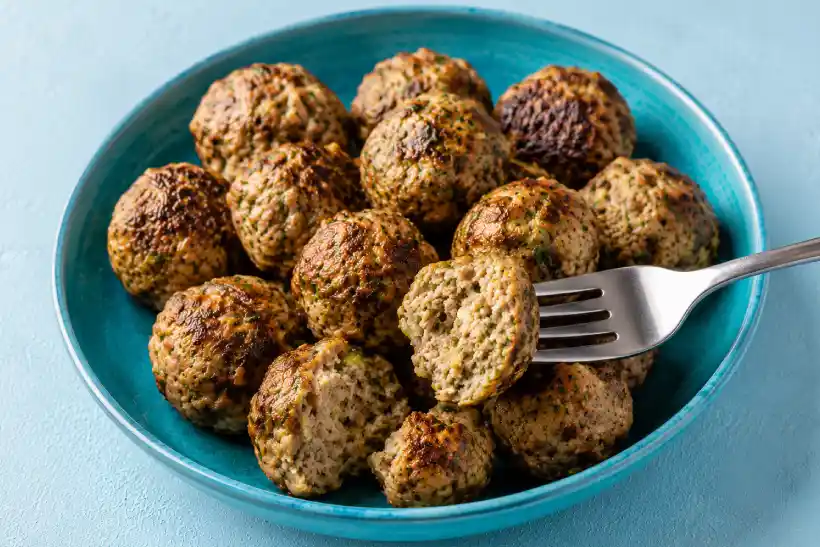
How to Keep Chicken Meatballs Tender
Moist chicken meatballs depend more on ingredient balance and temperature control than on adding a large amount of fat.
First, resist the urge to add dry binder just because the raw mixture feels softer than a beef meatball mixture. Breadcrumbs absorb moisture, so adding them without adjusting the recipe can produce a dense center.
Handle the chicken lightly. Mixing aligns and tightens meat proteins, while firm rolling compresses the portions. Both actions work against a soft texture.
Keep the meatballs small and consistent. A large meatball takes longer to reach 165°F in the center, which exposes the outside to more heat. The one-tablespoon size cooks quickly enough to limit moisture loss.
Temperature is the final control point. Check early and remove the pan promptly. Several current chicken-meatball recipes likewise emphasize gentle handling, added moisture, and avoiding overbaking, although their binders and flavor profiles vary.
Troubleshooting guide
| Problem | Likely cause | Practical solution |
| Dry or rubbery meatballs | Overcooking, extra-lean chicken, or heavy mixing | Use chicken with some fat, fold gently, and remove at 165°F |
| Dense texture | Mixture was kneaded or meatballs were packed firmly | Mix only until combined and shape with light pressure |
| Meatballs spread | Zucchini was too wet or portions were too warm | Press out dripping liquid and chill the mixture for 10 minutes |
| Meatballs fall apart | Incorrect egg or Parmesan measurement | Confirm the measured binder and let cooked meatballs rest for 5 minutes |
| Mixture sticks to hands | Normal tackiness from ground chicken | Portion with a scoop and dampen hands before rolling |
| Uneven cooking | Meatballs are different sizes | Use a level one-tablespoon scoop |
| Leftovers seem dry | Reheated uncovered or too long | Add sauce or a spoonful of water, cover, and heat gently |
If the mixture is too soft to scoop, chill it for 10 minutes before changing the ingredient ratio. Cold chicken fat and chilled proteins hold their shape more effectively. Adding extra Parmesan should be the second correction, not the first, because it also increases sodium and changes the nutrition estimate.
Bariatric Portion Size and Estimated Nutrition
There is no single correct number of meatballs for every bariatric patient. Meal capacity depends on the procedure, recovery stage, individual tolerance, protein target, and instructions from the bariatric care team.
The table below is a tracking tool rather than a portion prescription.
| Portion | Number of meatballs | Estimated calories | Estimated protein |
| Small portion | 2 | 100 | 11 g |
| Intermediate portion | 3 | 150 | 16 g |
| Standard recipe serving | 4 | 200 | 22 g |
Each mini meatball provides approximately 5.4 grams of protein and 50 calories. That makes a two-, three-, or four-piece serving easier to calculate without changing the recipe.
Estimated nutrition per serving
| Nutrition information | Estimated amount |
| Serving size | 4 mini meatballs |
| Calories | 200 |
| Protein | 22 g |
| Total carbohydrates | 1–2 g |
| Total fat | 12 g |
| Saturated fat | 4 g |
| Fiber | Less than 1 g |
| Total sugar | Less than 1 g |
| Sodium | 295 mg |
| Cholesterol | 120 mg |
Nutrition is estimated and may vary according to the ground chicken, Parmesan, yogurt, seasonings, and cooking spray used. Representative ingredient data from USDA FoodData Central was used as the general reference for these calculations.
Sauce and side dishes are not included. Add their nutrition separately, especially when tracking protein, carbohydrates, sodium, or added sugar.
When Can You Eat Bariatric Chicken Meatballs After Surgery?
There is no universal week when meatballs become appropriate after gastric sleeve or gastric bypass surgery.
Programs use different postoperative stages and advance patients according to healing, symptoms, tolerance, and clinical judgment. Mayo Clinic explains that postoperative diets generally progress from liquids to puréed foods, soft foods, and then firmer foods as tolerated.
Ground poultry may be introduced only after your surgeon or registered dietitian approves it. Even then, dry meat, large bites, or fast eating may be difficult to tolerate. This recipe’s moisture and small size can make portioning and chewing more manageable, but those qualities do not make it appropriate for every post-op diet stage.
When approved:
- Begin with the portion recommended by your care team.
- Cut the meatball into small bites.
- Chew each bite thoroughly.
- Eat slowly and pay attention to fullness.
- Use a light sauce when additional moisture is helpful.
- Stop eating if the food does not feel comfortable.
UCSF Health recommends eating slowly, taking small bites, and chewing food thoroughly after bariatric surgery.
Postoperative eating stages and individual tolerance vary. Follow the guidance of your bariatric surgeon or registered dietitian before adding these meatballs to your meal plan.
What to Serve With Bariatric Chicken Meatballs
A moist, lower-sugar sauce is often more useful than a large side dish. It adds flavor while reducing the dry sensation that can occur with reheated poultry.
Try a small amount of:
- Low-sugar marinara
- Plain Greek yogurt sauce
- Mild tzatziki
- Thinned pesto, when tolerated
- Low-sodium broth
- Sugar-free or low-sugar barbecue sauce
For vegetables, consider roasted zucchini, soft green beans, mashed cauliflower, cauliflower rice, zucchini noodles, cucumber salad, or a small green salad. Select the texture and quantity that match your approved food stage.
A practical protein-first plate starts with the meatballs. Add the sauce, then use the remaining meal capacity for vegetables or another approved side. Avoid letting a large volume of vegetables displace the protein amount your clinician has asked you to prioritize.
Check sauce labels carefully. Products marketed as “light” may still contain substantial added sugar or sodium, and spicy sauces may be uncomfortable during some stages of recovery.
Storage, Freezing, and Reheating
Bariatric chicken meatballs are well suited to meal prep because the batch can be divided into counted portions before refrigeration or freezing.
Refrigerating cooked meatballs
Cool the meatballs promptly and transfer them to shallow, airtight containers.
FoodSafety.gov lists cooked meat or poultry leftovers for 3–4 days in the refrigerator and 2–6 months in the freezer. For the best texture in this recipe, use frozen meatballs within about 3–4 months.
Packaging them in two-, three-, or four-meatball portions makes protein tracking simpler and prevents repeated warming of the entire batch.
Freezing
Arrange the cooled meatballs in a single layer on a parchment-lined tray. Freeze until firm, then transfer them to a labeled freezer bag or airtight container.
For the best texture, use frozen leftovers within about 3–4 months.
Alternatively, freeze individual meal-prep portions with a small amount of approved sauce. The sauce protects the surface from drying during reheating.
Reheating without drying them out
For the microwave, place one portion in a microwave-safe dish with 1–2 tablespoons of marinara, broth, or water. Cover loosely and heat in short intervals, turning the meatballs as needed.
For the oven, place the meatballs in a small covered baking dish with sauce. Heat at 325°F until warmed through.
Reheated leftovers should reach 165°F. Avoid an uncovered hot oven or extended air-fryer reheating, both of which can dry the exterior before the center is hot.
Variations and Common Mistakes
Recipe variations
Italian chicken meatballs: Keep the base seasoning and serve with low-sugar marinara. Fresh basil can be added after cooking when its texture is appropriate for your stage.
Mediterranean chicken meatballs: Replace the Italian seasoning with 1/2 teaspoon dried oregano and add 1/4 teaspoon ground cumin. Serve with plain Greek yogurt sauce or mild tzatziki.
Buffalo chicken meatballs: Replace the Italian seasoning with 1/2 teaspoon smoked paprika and 1/4 teaspoon dried dill. Coat the cooked meatballs lightly with a low-sugar Buffalo sauce. Spicy food is not suitable for everyone, particularly during early recovery.
Chicken Parmesan meatballs: Spoon a little low-sugar marinara over the cooked meatballs and add a small amount of shredded mozzarella. Return them to the oven only until the cheese melts. Include the topping in your nutrition totals.
Extra-zucchini meatballs: Increase the zucchini to 3/4 cup, squeeze it more firmly, and add one extra tablespoon of Parmesan. Chill the softer mixture for 10 minutes before shaping.
Gluten-free chicken meatballs: The base recipe contains no flour or breadcrumbs. Confirm that all packaged ingredients are labeled gluten-free when cross-contact matters.
Air-fryer chicken meatballs: Lightly spray the basket and arrange the meatballs with space between them. Cook at 375°F for approximately 9–12 minutes, checking early and continuing only until the centers reach 165°F / 74°C. Work in batches rather than crowding the basket.
Common mistakes to avoid
Using extra-lean chicken and then baking it for extra time is the most direct route to dry meatballs. Choose an appropriate ground-chicken blend and rely on the thermometer.
Do not overmix. Once the chicken and zucchini are evenly distributed, further stirring does not improve the mixture.
Large portions also create a texture problem. They need more time in the oven and are less convenient to divide into small bites.
Skipping the zucchini or yogurt without replacing their moisture changes the recipe. Egg alone binds the mixture but does not provide the same tenderness.
Finally, consider how the meatballs are eaten. A high-sugar sauce, rushed meal, oversized bite, or portion that exceeds current tolerance can work against the purpose of an otherwise carefully designed recipe.
Frequently Asked Questions
Are chicken meatballs good after bariatric surgery?
They can fit a protein-first bariatric meal after your care team has approved ground poultry and the texture suits your current stage. These bariatric chicken meatballs are small and moist, but they are not appropriate for every person or every postoperative phase.
When can I eat meatballs after gastric sleeve surgery?
There is no universal timeline. Bariatric programs advance patients through postoperative stages at different rates. Follow the ground-meat and texture guidance from your bariatric surgeon or registered dietitian rather than selecting a week from a general recipe.
How many meatballs can a bariatric patient eat?
Use the amount approved for your current meal capacity and protein plan. In this recipe, two meatballs provide about 11 grams of protein, three provide about 16 grams, and four provide about 22 grams.
How do you keep ground chicken meatballs moist?
Use ground chicken with some fat, retain a little moisture in the grated zucchini, add the measured Greek yogurt, and mix gently. Shape small meatballs and stop cooking as soon as the center reaches 165°F. Reheat leftovers covered with sauce or broth.
Can I make chicken meatballs without breadcrumbs?
Yes. Egg and finely grated Parmesan provide structure, while zucchini and Greek yogurt maintain moisture. The raw mixture will feel softer than a breadcrumb-based mixture, so portion it with a scoop and shape it with damp hands.
Can bariatric chicken meatballs be frozen?
Yes. Cool them promptly, freeze them in a single layer, and transfer them to portioned freezer containers. For the best quality, use them within 3–4 months and reheat with a little sauce until the center reaches 165°F.
Conclusion
Bariatric chicken meatballs work best when moisture, temperature, and portion size receive as much attention as protein. Finely grated zucchini and Greek yogurt soften the ground chicken, while egg and Parmesan provide enough structure to skip traditional breadcrumbs.
Keep the mixture slightly tacky, handle it gently, and use a thermometer instead of extending the baking time for deeper browning. With an estimated 5.4 grams of protein per meatball, the finished batch can be divided into clear two-, three-, or four-piece portions based on the plan provided by your bariatric care team.
More Bariatric Recipes
Looking for another easy protein option? Try this high-protein bariatric gelatin recipe for a quick snack that is simple to portion.
For a lighter dessert, this sugar-free bariatric gelatin recipe offers an easy make-ahead option with only 10 calories per serving.
You can also explore this easy bariatric gelatin recipe when you need a soft, high-protein snack that is ready in about 10 minutes.
Explore More Bariatric Chicken Recipes
Enjoyed this recipe? Discover our complete collection of bariatric chicken recipes, carefully created to help you enjoy simple, protein-rich meals every day.
Discover Our Bariatric Chicken Recipes Collection
Sources Used for Factual Claims
- USDA Food Safety and Inspection Service: Safe minimum internal temperature for ground poultry, thermometer use, leftover storage, freezing, and reheating guidance.
- UCSF Health: Post-bariatric dietary progression, protein-rich food choices, and individualized protein guidance.
- Mayo Clinic: General gastric-bypass diet progression and the importance of following the patient’s clinical plan.
- USDA FoodData Central: General reference data used to estimate nutrition from standard ingredients.
- Mather Hospital Bariatric Nutrition Team: Zucchini-based mini chicken meatball format and moisture-focused recipe context.
- Rex Bariatrics: Bariatric chicken-meatball search-intent and recipe-format comparison.
- Nourished Simply: Mini Buffalo chicken-meatball format and bariatric-focused texture context.
- Real Life Nutritionist: Breadcrumb-free baked chicken-meatball search-result comparison.
- Publisher-provided SEO research brief: Recipe scope, target reader questions, and required editorial coverage.